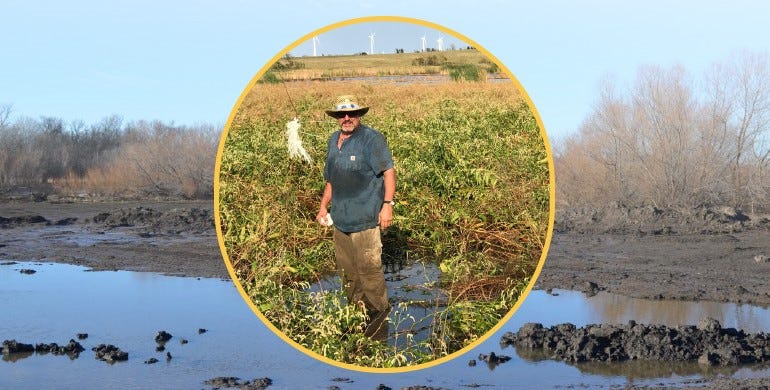
When Scott Rennick was nine years old, his dad took him on an adventure that inadvertently steered the course of his life. Rennick’s dad took him duck hunting in the wetlands of Bakersfield, California, just a few hours from their home in Los Angeles. It was at this young age that he became fascinated by wetlands. He already knew city life wasn’t for him, but being introduced to the wetlands gave him a glimmer of what his future could look like. This one trip built a passion in Rennick he would follow for the rest of his life.
The United States Environmental Protection Agency (EPA) defines wetlands as “areas where water covers the soil, or is present either at or near the surface of the soil all year or for varying periods of time during the year, including during the growing season.” The EPA goes on to add that “Wetlands may support both aquatic and terrestrial species. The prolonged presence of water creates conditions that favor the growth of specially adapted plants (hydrophytes) and promote the development of characteristic wetland (hydric) soils.”
Wetlands are beneficial to the environment, humans, fish and wildlife. The EPA says “Wetland functions include water quality improvement, floodwater storage, fish and wildlife habitat, aesthetics and biological productivity.” One of the species wetlands support are ducks. Wetlands provide food and cover that ducks need as they migrate on their various paths.
Rennick’s fascination with migratory birds and wetlands continued to grow as he did. He says biology always made sense to him, so diving into biological sciences was a natural fit for him. In high school, he did a three-year waterfowl population study in Coachella Valley that involved monitoring bird species at golf courses in the area. Rennick would monitor the variety of species he encountered and the times of year they were present in each location. He built his first wetland in Hemet, California, at the age of 18.
After California, he spent many years in both Kansas and Colorado, before he and his wife “retired” to our area. The term retired is used very loosely, since Rennick is still busy building and monitoring various wetland projects, monitoring migratory bird species and writing books.
Over the last 50 years, the number of wetlands has been decreasing for a number of reasons – climate change, urbanization, population increases and agricultural purposes. This is where Rennick comes into the picture. He restores and rebuilds wetlands. While he is experienced enough to be able to tell if a particular area used to be a wetland, Rennick explains that soil core samples can also be taken to scientifically prove an area used to be a wetland.
Some landowners want to build wetlands back in to help improve the quality of their water. Some landowners want to build wetlands purely for the beauty it brings to the property. Wetlands are not a static environment. They are changing all the time. Different bird species spend time on, and pass through wetlands on their migratory paths. The variety of plants also changes as water levels and seasons fluctuate. Rennick sees the ever changing character of wetlands as part of nature’s magic.
He calls the wetlands project he’s working on now his Sistine Chapel. The wetlands he’s building are on a 90-acre property. Rennick will develop wetlands on approximately 60 of the 90 acres. He explains, “There’s actually going to be two separate structures. One down at the bottom will be about 28 acres. Then there will be an upper wetland, which will be about 32 acres. The reason we’re doing that is so we can dry one and keep the other one full of water.” Rennick says his method with these wetlands will act like a biological water pump. They will pump water out of a nearby creek to fill the first wetland, then the water will go back into the creek when it flows out of the lower wetland. He goes on to add, “There’s really no net loss of water except some evaporation.”
A fascinating aspect of wetlands are the seed banks which exist in the soil, even if the wetland has been drained. The seed bank for a wetland holds dormant seeds from plants that grew when the wetlands were in existence. Dry soil conditions are not the right conditions for these plants to grow. But once a wetland has been reintroduced, many of the plants will begin to grow again after only a few seasons. The soil literally holds on to a bank of seeds for plants it knows are beneficial to its natural and preferred state of being.
Rennick also goes on to shed some light on what it takes to make the dream of building a wetland come to life. “It takes a while to develop a wetland. The physical work of building the terraces and things like that is short. For this particular project, which is going to be about 60 acres of wetland, it’ll take me a month of heavy equipment work to build it.” He explains that terraces are similar to dams but much smaller. Rennick says the physical work is the easy part. “The hard part is the development and managing it while it develops and matures and making sure that the right things are growing and the wrong things aren’t growing.”
When asked why he’s chosen this particular path, he sums it up pretty succinctly, “It’s a fascination; it’s a passion; and it’s a necessity. Wetlands are necessary. It’s about water quality, aesthetics, which includes hunting, migratory bird populations and carbon sequestration.” He adds that the more he learns, the more he knows that there is nothing accidental about wetlands. Historically, the processes that have created them are complex. They were meant to exist, and Scott Rennick is meant to care for them.