Members
Coming Together for Community
Story by Marlys Cervantes | Staff Writer
The following article appeared in the print issue of Ponca City Monthly magazine, which includes hyperlocal stories about Ponca City. Get full access to all online articles, videos, and content by becoming a paid subscriber. We offer free and paid subscription plans. Find rack locations to pick up your free print copy here, or subscribe here to get online access plus exclusive content.
“Innovation is taking two things that already exist and putting them together in a new way.”
~ Tom Freston, American Media Financier
Church attendance has been declining even prior to COVID-19, and since then many congregations have found it difficult to bounce back from where they were pre-pandemic. Nationwide, the struggle is real, with those who desire to continue in their worship and outreach looking for solutions to keep their doors open to serve their current members while they continue to look for ways to meet the needs within their communities.
In Ponca City, Oklahoma, First United Methodist Church and First Presbyterian Church have recently come together after months of collaboration in a partnership that very well may be a model that could work for other churches as well. But what led to the need for this? What made two previously vibrant churches struggle and led one to come close to the need to close their doors altogether?
In his article “Church Attendance Has Declined in Most U.S. Religious Groups,” Jeffrey M. Jones states that a March 2024 Gallup poll indicates 3 in 10 U.S. adults attend religious services regularly, with 11% attending once a month and 56% seldom attending services. Only two decades ago the U.S. averaged 42% attending every week or nearly every week (instead of the current 30%). One decade ago, the average was 38%.
It appears that the most likely reason is the rise in younger adults (18-29-year-olds) being less likely to belong to or attend church even if they identify with a particular religious group, such as Protestant Christian or Catholic, for instance.
However, there are a growing number of Americans with no religious affiliation. In the years 2001-03, there were only 9% who had no affiliation, but in 2021-23, the numbers had grown to 21%.
What is maybe most interesting in all of this, especially since many of us tend to blame much of the decline on the recent pandemic, is to look at an earlier Gallop poll. In March 2021 Jones reported that U.S. church membership dropped below the majority for the first time since it had been tracked: “In 2020, 47% of U.S. adults belonged to a church, synagogue or mosque.”
However, before that it had been much higher. Membership had been 70% in 1999 and dropped to 50% by 2018. When Gallup first measured U.S. church membership in 1937 it was 73%, which means it remained near 70% for the next six decades before the decline began. Again, much of this may be from a drop in religious affiliation, often possibly when people move and don’t find new home churches, and due to those younger adults who never establish an affiliation.
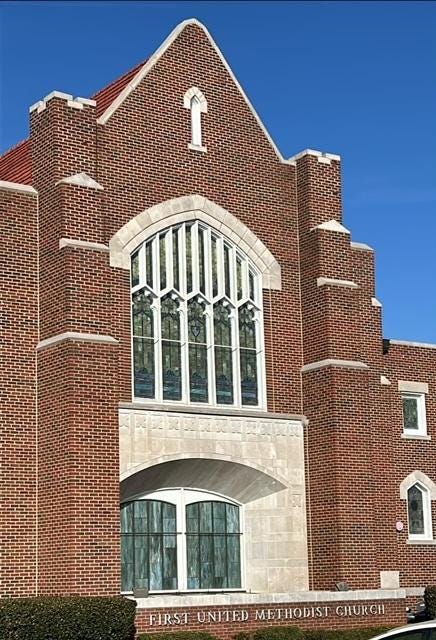
This decline is precisely what happened for First Presbyterian Church. Ann Salmons, choir director at FPC, explains what they’ve experienced, “For the past 10 years, we have watched not only our people becoming fewer and the age of our members getting older, but also the growing cost of maintaining and repairing our facility. We tried many different avenues, such as looking for organizations to rent part of the building, shutting off part of the building or downsizing to another building.”
Salmons continues, “Our members were not ready to just close the doors to our ministries. We strongly felt God had more for us to do. Our church still had a heartfelt call to reach people through worship and mission.”
First United Methodist Church had made changes due to a decreasing membership as well, moving from two worship services on Sundays to one and decreasing staff positions. They had moved services during COVID-19 onto a television, and the broadcast helped keep congregants knowledgeable about others who they weren’t seeing regularly. However, as with any decision like this, it was then slow moving people back into the pews once it was time since there were still cautions to be taken. So, both churches were hurting.
Salmons mentions FPC felt God tugging them to investigate working with another church. So, with continuing low numbers, leaders from FPC approached Pastor Leon Veazey about possible solutions and leaders from both congregations began discussions and brainstorming. In the discussions, Pastors Leon Veazey and Mark Southard, along with leaders from the churches, believed the two churches would be good for one another. They suggested joining in partnership with each keeping their own identity. Two denominations joining together in their worship and missions. It had never been done before and, while it seemed a stretch, it felt like the perfect idea.
Gay Norris, member of FPC and Clerk of the Session says, “I’d have to say that the sadness and trepidation of ‘leaving’ our long-time home has been replaced ten-fold by the incredible welcome we have received from our new church family. So many of us walked in being greeted by long-time friends and neighbors, and at the same time were embraced by total strangers that instantly are becoming new friends. I think FPC has found a vibrant, passionate church family. The union is truly a ‘road less travelled’ but is taking us on a healing journey for our congregation. I am beyond happy and hopeful!”
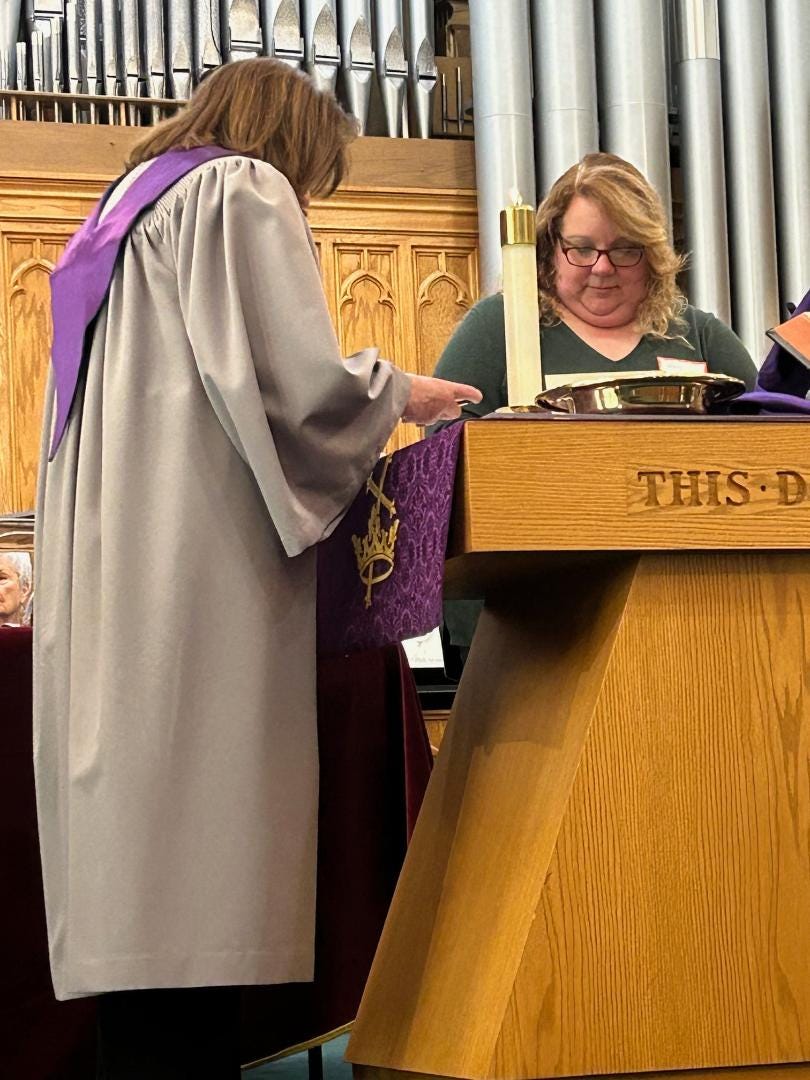
Norris’ counterpart from FUMC in formally signing the partnership once it was finally polished was Teri Harris, FUMC member and Chair of Church Council. Of the process and looking forward, Harris says, “As a leader and long-term member of the church, I have truly enjoyed this opportunity to worship together. I believe each church had strengths that the other did not, and our partnership will allow us together to reach more people in our community than ever before. From a theological perspective, I believe we’ve just started to scratch the surface of what we can learn from one another.”
There are many areas where the two churches come together, and none are so obvious as in music. Director of Music Ministry at FUMC, Marta Sullivan, expresses her joy at the added fullness of the choirs: “The coming together of voices and bells has been a profound blessing. The additional talent has grown the Chancel choir from an average number of 15 singers to an average of 25 and the Carillon handbell choir, struggling with enough ringers to play three octaves of bells, now has a surplus of ringers allowing the group to play five octaves of bells with a couple positions duplicated. This surplus of seasoned talent has not only extended the choir's range, but has also sparked the creation of a handbell ensemble.”
For a church that had such a depth in its music program in the past, this growth has been welcomed by all. Sullivan says, “In addition to simply having a fuller and more robust sound with additional voices and bells, having more participants opens opportunities for offering more intricate and challenging musical pieces. This is especially true when the participants from both churches are highly talented with a wealth of experience. Directing these choirs has been a joy, and I am truly overwhelmed with gratitude for the limitless worship opportunities that lie ahead.”
Pastor Leon Veazey, FUMC Sr. Pastor and the pastor with oversight for worship and other ministry elements as the churches work together in the joint ministry, expresses the beauty of the ecumenical partnership between the two, saying, “The worship experience has been wonderful with the merger of two great choirs and handbell ensembles, and an additional choir director who has already filled in for one service and served jointly with the choir director of FUMC on a couple of occasions. We also gained a soloist who is well-known in our community as a gifted vocalist. We have incorporated liturgy from the Presbyterian Church USA and utilized liturgists from their church in some of our worship services in order to honor both traditions.”
It would seem both congregations understand the joy and blessings of joining in this ministry and the beauty of diversity in worship. Volunteers from both congregations have joined in providing for the children’s and youth ministries, with both expected to grow as they move forward.
Possibly some of the most excitement has been the converging of mission ministries of the two congregations. Volunteers from both churches have come together in support of one another’s previous missions and helped ensure that all can continue. This is how service to God continues in great richness.
Salmons expresses this new ministry style as one in which God will do something wonderful. She says, “From the beginning, the congregation at First United Methodist Church has made us feel more than welcome, they have worked hard to help us feel at home. They have been wonderful to let us bring our mission opportunities and activities into their church life. We have joined our youth and our music departments, both congregations are supporting our Coryell Cupboard, our baskets with supplies for nursing homes and The Mission, and our Czech Camp Mission. They have opened their arms to us. It is sort of like relatives who have lived apart getting back together again. It is a joy!”
The partnership is not a merger. Each church retains its identity but enters into a “Memorandum of Understanding” of Partnership instead with the purpose expressed as an agreement “for these two congregations to support each other in the fulfillment of their shared vision to effectively witness to the grace of Jesus Christ to make disciples for the transformation of the world,” and it specifically states the agreement is “in a spirit of mutual trust, respect and shared commitment to Christian doctrine as each entity understands it.” No one is trying to change anyone else; both congregations are in support of the other.
The details of the agreement are specific and cover Mission, Responsibilities and Obligations (Intent of Agreement; Location and Property; General Pastoral Responsibilities; Worship, Sacraments and Pastoral Rites; Financial Management; Governance), Supervision, Terms of Understanding and Ratification of MOU. There was an Advisory Team that met and fleshed out the details of the Memorandum, with consultants including one leader each from the greater organizations of Methodist and Presbyterian Churches to oversee it.
This is no small feat, and while the details and time coming to them was extensive, the coming together of people came with great ease. It felt like friends coming together since so many had been friends for years, or served on community organizations together already, or worked together. The Advisory Committee still meets regularly, with two lay members from each church, the pastor of FUMC and the presiding elder of FPC Session to work on details as the partnership moves forward.
However, most importantly, the commitment is there. Pastor Veazey says, “The body of Presbyterian parishioners who have been so committed to this enterprise express great character in their acceptance of this new chapter in their church life and have been so inspiring to us at First United Methodist Church! We are honored and pleased to call them part of our worship family!”
Now, the key is continued growth for all. In Gallup’s poll several points were mentioned that were key to what congregants want in their church. The primary reason they attended church was for a sermon that inspires them (no pressure, Pastor!). Other reasons were “spiritual programs geared toward children and teenagers, community outreach and volunteer opportunities, and dynamic leaders.”
If we are involved in our churches, we need to ensure the community around us knows what we offer—both internally for our members and externally for the community. Also, many young adults want a church that reaches out to the community. The togetherness in this partnership has helped these two churches do just that. FUMC and FPC have embraced one another and their missions in the community, and this will help them be vibrant in their worship services, as well as throughout their service to their community!
“Two are better than one, Because they have a good return for their hard work.”
~ Ecclesiastes 4:9
➡️ Opt in or out of different newsletters on your “My Account” page.
➡️ Learn more about Ponca City Monthly+
Ponca City Monthly is a locally owned publication that delivers hyperlocal news in print and online.
Like what we are doing? Feel free to forward this along and tell a friend.
Sponsorship information/customer service: email editor@poncacitymonthly.com